FHA vs conventional: which costs less on a small down payment?
With less than 20% down, you'll pay for mortgage insurance either way. FHA charges everyone roughly the same; conventional PMI is priced by your credit score. So the cheaper loan depends mostly on your score, and on how long you'll keep the loan. Here's the comparison on one house.
1. How the two loans charge for insurance
| FHA | Conventional | |
|---|---|---|
| Upfront | 1.75% of the loan, usually added to the balance | None |
| Yearly | 0.50–0.55% of the loan for most 30-year loans, whatever your credit score | PMI, priced by credit score and down payment |
| How long | The life of the loan with under 10% down; 11 years with 10% or more | Ends on its own at 78% of the original value; you can ask to cancel at 80% |
| Minimum down | 3.5% (credit score 580+) | 3% for first-time buyers |
| Debt-to-income limits | 31% for housing, 43% for all debts (manual underwriting) | Up to 45%, sometimes 50%, for all debts; no separate housing limit |
2. Same house, four credit scores
A $400,000 home with 5% down, a 6.5% rate for 30 years, property tax of 1.1%, and $200 a month for insurance and HOA dues. The FHA loan includes its $6,650 upfront premium in the balance.
| Credit score | Conventional: PMI | Conventional: monthly total | FHA: premium | FHA: monthly total | Over 7 years, FHA costs |
|---|---|---|---|---|---|
| 760 | $127 | $3,095 | $158 | $3,169 | $11,066 more |
| 720 | $174 | $3,143 | $158 | $3,169 | $7,076 more |
| 680 | $253 | $3,222 | $158 | $3,169 | about the same ($426 more) |
| 620 | $364 | $3,333 | $158 | $3,169 | $8,884 less |
"Over 7 years" counts all the interest and mortgage insurance paid in seven years, plus the difference in what you'd still owe (the FHA balance is higher because of the upfront premium). The crossover is around a 680 score: above it, conventional usually wins; below it, FHA does.
3. The long-run catch: FHA's premium doesn't end
With under 10% down, FHA's yearly premium lasts as long as the loan. Conventional PMI on the same house ends after about 12 years on schedule, sooner if you pay extra or ask at 80%. So the longer you keep the loan, the more conventional pulls ahead.
The usual way out of FHA's premium is to refinance into a conventional loan once you have 20% equity. That only makes sense if rates are similar or lower then. A borrower who takes FHA today and can't refinance later pays the premium for the full term.
4. Other things that tip the choice
- Interest rates differ. Lenders price FHA and conventional loans separately, and FHA rates are sometimes a little lower. The calculator uses one rate for both, so compare real quotes.
- Debt-to-income. FHA's manual limits (31% and 43%) are stricter on paper, but automated approvals often allow more. Conventional allows up to 45% or more with no separate housing limit.
- The property. FHA has its own appraisal standards for the home's condition, and some condos must be FHA-approved.
- Loan limits. FHA's 2026 limit for a one-unit home is $541,287 in most counties, higher in expensive areas. Conventional conforming loans go up to $832,750 in most counties.
5. How to decide
- Check your credit score. Around 700 or above, start with conventional.
- Get quotes for both, with the same down payment, and compare the monthly total and cash to close.
- Think about how long you'll keep the loan. Longer favors conventional, because its PMI ends.
- If you take FHA, plan the refinance: track your equity and rates once a year.
Try it with your numbers
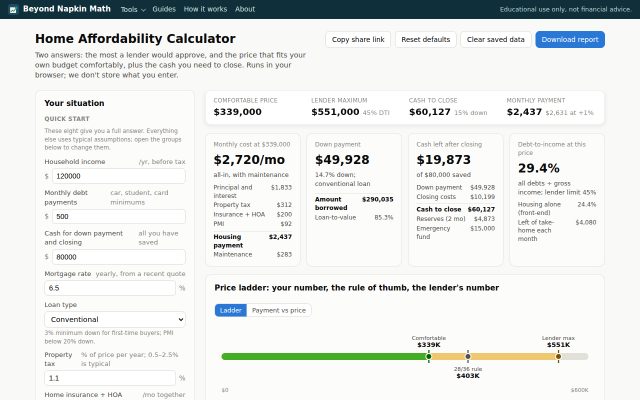
The Home Affordability Calculator opens with an FHA loan, 5% down and a 680 score. Switch the loan type between FHA and conventional, and set your own credit score and cash. It shows how the price you can afford and the monthly cost change. The PMI rates are estimates by credit band; your lender's quote is what counts. It runs in your browser and we don't store your numbers.
More guides for this tool
- DTI explained: the debt-to-income limits mortgage lenders use
- How much down payment do you need? 3%, 5%, 10% or 20%
- How much house can I afford? The lender's number vs. your number
- What a 1-point change in mortgage rates does to the house you can afford
 Run your own numbers
Home Affordability Calculator
The lender's number vs. your number, with the cash you need to close.
Open the tool →
Run your own numbers
Home Affordability Calculator
The lender's number vs. your number, with the cash you need to close.
Open the tool →