The 4% rule: where it comes from, and when it's the wrong number
"Save 25 times your spending and withdraw 4% a year" is the most quoted rule in retirement planning. It's a reasonable start for someone retiring in their mid-60s. It isn't a law of nature: it comes from one study of past U.S. markets over 30-year periods, and stretching it over a 45-year early retirement, or ignoring taxes, can leave a plan short by a million dollars.
1. What the rule actually says
In 1994, financial planner William Bengen looked at every 30-year retirement starting from 1926 onward. He asked: what first-year withdrawal, raised each year with inflation, never ran out of money with a mix of stocks and bonds? The answer, in the worst starting year, was about 4% of the starting balance. A later study from Trinity University found similar results.
Three things are easy to miss:
- 4% is of the starting balance, then the dollar amount rises with inflation. It isn't 4% of whatever the portfolio is worth each year.
- It's the worst case of the historical periods. In most periods, retirees following it ended with more than they started with.
- It assumed 30 years. Longer retirements face more bad markets.
2. Longer retirements need lower rates
The Retirement Plan Explorer sets the rate from the length of retirement (to age 95 by default):
| Years of retirement | Suggested rate | Multiple of spending |
|---|---|---|
| 20 or fewer | 4.5% | 22× |
| 21 to 30 | 4.0% | 25× |
| 31 to 35 | 3.7% | 27× |
| 36 to 40 | 3.5% | 29× |
| 41 to 50 | 3.25% | 31× |
| Over 50 | 3.0% | 33× |
These are the calculator's assumptions, in line with long-horizon research on historical returns, not official figures. You can turn them off and enter your own rate.
3. What a half-point is worth
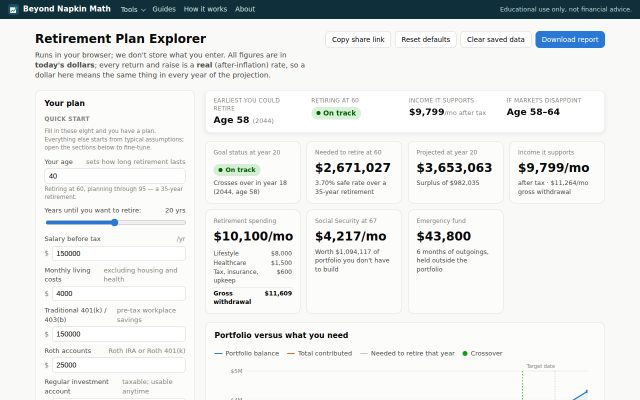
A 40-year-old household earning $150,000 wants $8,000 a month to spend in retirement, plus $1,500 for health insurance and $600 for property tax, insurance and upkeep: $10,100 a month after tax, about $139,300 a year before tax at a 13% rate. With Social Security counted from 67:
| Withdrawal rate | Savings needed to retire at 62 | Reached at age |
|---|---|---|
| 4.5% | $2.23 million | 60 |
| 4.0% | $2.51 million | 61 |
| 3.5% | $2.87 million | 63 |
| 3.0% | $3.35 million | 65 |
Each half-point is roughly a year or two of work. That's why the rate deserves more thought than any other single input.
4. Two things the rule leaves out
- Taxes. The rule gives a gross withdrawal. If your money is mostly in a traditional 401(k), part of each withdrawal goes to tax. Divide what you want to spend by (1 − your tax rate) before applying 4%.
- Social Security and pensions. They cover part of spending, so the portfolio needs to cover less. In the example, Social Security lowers the target by about a million dollars. But it starts at your claiming age, not when you stop work.
5. When the rule fails, and what people do about it
The 4% rule failed only when a retirement started just before a long stretch of poor returns: the late 1960s, when stocks went nowhere for years while inflation ran high. The order of returns matters more than the average (see sequence-of-returns risk). In the calculator's stress tests, a "lost decade" just before retiring pushes this household's date from 62 to 69.
Flexible spending helps more than a lower starting rate. Common approaches: skip the inflation raise after a down year, cut spending by 10% when the portfolio falls well below its starting value, or keep a year or two of spending in cash so you don't sell stocks in a crash.
Try it with your numbers
The Retirement Plan Explorer opens with this household. Enter your spending, savings and income. It sets a withdrawal rate from your retirement's length, or uses the rate you enter, shows the savings you need for each possible retirement year, and runs five historical-style stress tests. Our guide to how much you need to retire early covers the rest. It runs in your browser and we don't store your numbers.
More guides for this tool
- Health insurance before Medicare: budgeting for it in early retirement
- How much do you need to retire at 50? A worked example
- How much do you need to retire early?
- Retire at 60 or at 65? What the extra five years are worth
- Retiring before 59½: the Rule of 55, 72(t) and the bridge years
- Sequence of returns risk: why the order of market returns matters more than the average
 Run your own numbers
Retirement Plan Explorer
When could you retire? 401(k), Roth and taxable savings, in today's dollars.
Open the tool →
Run your own numbers
Retirement Plan Explorer
When could you retire? 401(k), Roth and taxable savings, in today's dollars.
Open the tool →