Health insurance before Medicare: budgeting for it in early retirement
Medicare starts at 65. Retire at 55 and you need ten years of health insurance with no employer paying most of the premium. It's often the biggest cost early retirees underestimate, and since 2026, when the extra marketplace subsidies of 2021–2025 ended, it can depend on your income in a way that makes one extra dollar cost thousands.
1. The options
- COBRA: keep your employer's plan for up to 18 months, paying the full premium plus up to 2%. Familiar, but usually expensive, and only a bridge.
- A working spouse's plan: often the cheapest option, if one spouse keeps working.
- Retiree coverage: some employers and public pensions still offer it. Check before you set a date.
- The ACA marketplace (healthcare.gov or your state's exchange): plans can't turn you down or charge more for health conditions. Leaving a job lets you enroll outside open enrollment. Premiums depend on age (a 64-year-old pays up to three times a 21-year-old's rate), location and plan level.
- Health sharing ministries aren't insurance and don't have to pay claims. Treat them with care.
2. How marketplace subsidies work in 2026
The premium tax credit limits what you pay for the benchmark (second-cheapest silver) plan to a share of your income:
- From about 2% of income at the lowest incomes up to 9.96% between 300% and 400% of the federal poverty level.
- Above 400% of the poverty level, there's no subsidy at all. For 2026 coverage, that's $62,600 for one person and $84,600 for a couple.
- The credit is paid in advance from your estimated income and settled on your tax return. From 2026, if your income ends up higher than estimated, you repay the excess in full.
The enhanced subsidies of 2021 to 2025 removed the 400% cliff and lowered the percentages. They expired at the end of 2025. Congress could change this again; check healthcare.gov for the current year.
3. The cliff, in dollars
An illustration: a couple in their early 60s whose benchmark plan costs $2,000 a month ($24,000 a year). The premium varies widely by location; your state's marketplace shows the real figure.
| Household income | Most they pay for the benchmark plan | Subsidy |
|---|---|---|
| $84,000 (just under 400%) | $8,366 (9.96%) | $15,634 |
| $85,000 (just over) | $24,000 | $0 |
One extra thousand dollars of income costs them over $15,000. The income that counts is modified adjusted gross income: wages, traditional IRA and 401(k) withdrawals, Roth conversions, capital gains, taxable interest and dividends, the taxable part of Social Security, plus tax-exempt interest. Spending Roth contributions or cash, or selling investments with small gains, doesn't add much to it. That makes early retirees unusually able to manage their subsidy, and it's one more reason to hold some savings outside pre-tax accounts.
4. What it does to the retirement target
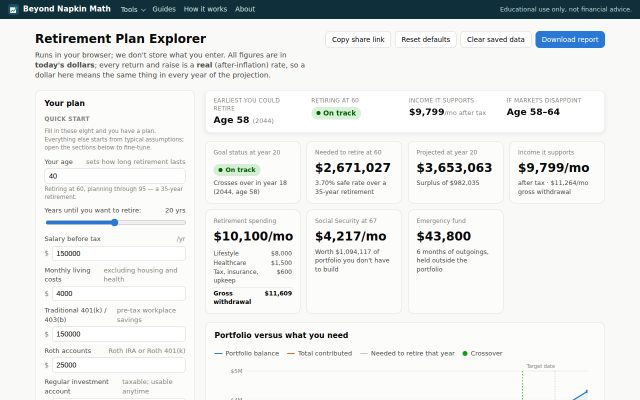
In the Retirement Plan Explorer's example household, which spends $10,100 a month after tax including $1,500 for health insurance, each $1,000 a month of health costs adds about $424,000 to the savings needed to retire at 50, and about $345,000 at 65. The calculator applies the cost for the whole retirement, which also stands in for Medicare premiums, supplemental coverage and out-of-pocket costs after 65.
For budgeting, separate three parts: the premium (from the marketplace, at your expected income), the deductible and out-of-pocket maximum (a bad year can add several thousand dollars), and dental and vision, which most plans leave out for adults.
5. Planning moves
- Price it before you set a date: the marketplace lets you see real premiums for your age and zip code at different incomes.
- Plan your income year by year to stay below the 400% line, or accept the full premium and use the high-income years for Roth conversions.
- Max out an HSA while you still work. HSA money pays medical costs tax-free at any age, including marketplace deductibles. See HSA or PPO?
- Sign up for Medicare on time at 65. Late enrollment penalties last for life.
What this leaves out
The subsidy rules here are the 2026 federal rules; some states add their own help, and Medicaid covers households at the lowest incomes in most states. The illustration's premium is hypothetical. Health policy changes often: check the current year's rules before you rely on a subsidy.
Try it with your numbers
The Retirement Plan Explorer opens with the example household retiring at 55. Enter your health insurance budget in retirement with your other spending. It shows how the cost changes the savings you need and the year you can retire. Our guide to how much you need to retire early covers the other pieces. It runs in your browser and we don't store your numbers.
More guides for this tool
- How much do you need to retire at 50? A worked example
- How much do you need to retire early?
- Retire at 60 or at 65? What the extra five years are worth
- Retiring before 59½: the Rule of 55, 72(t) and the bridge years
- Sequence of returns risk: why the order of market returns matters more than the average
- The 4% rule: where it comes from, and when it's the wrong number
 Run your own numbers
Retirement Plan Explorer
When could you retire? 401(k), Roth and taxable savings, in today's dollars.
Open the tool →
Run your own numbers
Retirement Plan Explorer
When could you retire? 401(k), Roth and taxable savings, in today's dollars.
Open the tool →