Retire at 60 or at 65? What the extra five years are worth
The last few working years do more for a retirement plan than any others. Each year adds savings and growth, removes a year of withdrawals, and shortens the retirement the money has to last. For the household below, the five years from 60 to 65 turn a plan that falls short into one with almost a million dollars to spare.
1. The household
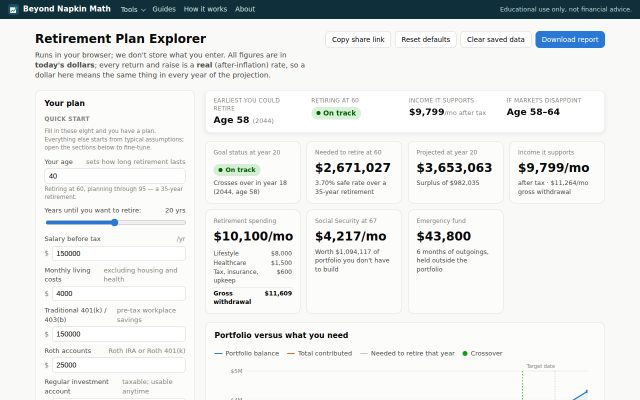
Aged 40, earning $150,000, with $175,000 in retirement accounts (including a Roth IRA) and $50,000 in a brokerage account. They save the 401(k) limit, get a $6,000 match, and invest what's left over after spending. In retirement they want $8,000 a month to spend, plus $1,500 for health insurance and $600 for housing costs that don't end: $10,100 a month after tax. Investments earn 5% a year after inflation; all figures are in today's dollars.
2. Five more years, four effects
| Retire at 60 | Retire at 65 | |
|---|---|---|
| Years of retirement (to 95) | 35 | 30 |
| Safe withdrawal rate | 3.7% | 4.0% |
| Savings needed | $2.78 million | $2.41 million |
| Savings projected | $2.39 million | $3.32 million |
| Gap | $381,000 short | $910,000 to spare |
| What the savings alone can pay, a month after tax | $6,424 | $9,641 |
- More savings: five more years of contributions and growth add $930,000.
- Less to fund: the target falls $361,000, because the retirement is five years shorter and a 30-year retirement supports the classic 4% rate.
- Less of a wait for Social Security: the household claims at 67 either way, so it covers more of a shorter retirement.
- Medicare at 65: retiring at 65 removes five years of buying health insurance on your own, often the largest cost early retirees underestimate.
In this example, the plan first works at 62. Each year before that leaves a shortfall; each year after adds a cushion.
3. The middle options
- Retire at 62: the savings reach the target, with no margin for a bad market.
- Spend less: cutting the $8,000 to $6,500 moves the date about two years earlier.
- Work part time from 60 to 65: even covering half your spending from pay halves the withdrawals in those years and leaves more time for savings to grow.
- Delay Social Security to 70 while living on savings: a higher benefit for life, worth considering if the savings can carry the extra years.
4. The risk on the other side
Working longer isn't always possible: health, layoffs and caregiving end many careers earlier than planned. Surveys of retirees regularly find that close to half stopped working earlier than they planned. A plan that only works at 65 needs a fallback for 60: what spending you'd cut, and which savings you'd draw first.
What this leaves out
The calculator uses a single steady return; its stress tests show how a bad decade changes the date. It assumes your pay keeps pace with inflation, no big inheritances, and that your spending in retirement stays flat in today's dollars. Many retirees spend more in their 60s and less in their 80s, apart from health costs.
Try it with your numbers
The Retirement Plan Explorer opens with this household. Enter your age, income, savings and the spending you want. It shows the savings you'd need and the savings you'd have for every possible retirement year, and the first year they meet. Change the horizon to compare 60 and 65 directly. See also the 4% rule. It runs in your browser and we don't store your numbers.
More guides for this tool
- Health insurance before Medicare: budgeting for it in early retirement
- How much do you need to retire at 50? A worked example
- How much do you need to retire early?
- Retiring before 59½: the Rule of 55, 72(t) and the bridge years
- Sequence of returns risk: why the order of market returns matters more than the average
- The 4% rule: where it comes from, and when it's the wrong number
 Run your own numbers
Retirement Plan Explorer
When could you retire? 401(k), Roth and taxable savings, in today's dollars.
Open the tool →
Run your own numbers
Retirement Plan Explorer
When could you retire? 401(k), Roth and taxable savings, in today's dollars.
Open the tool →