Retiring before 59½: the Rule of 55, 72(t) and the bridge years
Most retirement savings sit in 401(k)s and IRAs, which charge a 10% penalty on withdrawals before 59½ on top of income tax. Retire at 50 or 55 and you need to live for years on money you can actually reach. There are four standard ways to bridge that gap. Each has rules that trip people up.
1. How big the bridge is
A household planning to spend $10,100 a month after tax (about $139,300 a year before tax) and retiring with the savings the Retirement Plan Explorer projects:
| Retire at 50 | Retire at 55 | |
|---|---|---|
| Years until 59½ | 9.5 | 4.5 |
| Spending to cover before 59½ | $1.32 million | $627,000 |
| Reachable without penalty (taxable account plus Roth contributions) | $388,000 | $606,000 |
| Shortfall | $935,000 | $21,000 |
Retiring at 55 nearly works with ordinary savings. Retiring at 50 doesn't, without one of the tools below.
2. The Rule of 55
If you leave your job in or after the year you turn 55, withdrawals from that employer's 401(k) or 403(b) are free of the 10% penalty. (Age 50 for some public safety workers.)
- It covers only the plan of the job you leave then. Money in IRAs, or in old employers' plans, doesn't qualify, so consider rolling old 401(k)s into your current plan before you leave, if the plan accepts them.
- Don't roll that 401(k) into an IRA after you leave; you'd lose the exception.
- Leaving at 54 and waiting until 55 doesn't work. The separation has to happen in the year you turn 55 or later.
- Check the plan's rules: some allow only a lump sum, not regular withdrawals.
In the example, using the Rule of 55 on the whole pre-tax balance closes the bridge at 55 completely. It does nothing for retiring at 50.
3. 72(t): substantially equal periodic payments
At any age, you can take penalty-free withdrawals from an IRA if you take a fixed series of payments worked out by an IRS-approved method, and keep taking them for five years or until 59½, whichever is later.
- How much: under the amortization method with the maximum 5% rate allowed, a 50-year-old's payments are about 6% of the balance a year. The $620,000 pre-tax balance in the example would give about $37,200 a year.
- The catch: change the payments, or add to or take extra from that IRA, before the period ends, and the 10% penalty applies retroactively to every payment, plus interest.
- A workaround: split your IRA first, so the 72(t) account holds only what's needed for the payment you want, and the rest stays flexible.
4. Roth contributions
What you put into a Roth IRA (not the growth) can come out at any age, tax- and penalty-free. Converted money can come out penalty-free five years after each conversion. A "Roth conversion ladder" converts a slice of a traditional IRA each year in early retirement, at low tax rates, to spend five years later. It works, but the first five years need other money.
5. A taxable account
An ordinary brokerage account has no age rules at all. Long-term gains are taxed at 0% for a married couple with taxable income up to about $98,900 in 2026. For early retirees, it's often the simplest bridge, which is why many keep saving there once the 401(k) match is taken.
6. What this leaves out
The calculator treats all pre-tax savings as reachable from the age you set (59½ by default, or 55 if you'll use the Rule of 55); it doesn't model 72(t) payments or a Roth ladder. HSAs, 457(b) plans (no penalty after leaving the employer at any age) and the newer exceptions for emergencies are also left out. A tax professional can check a 72(t) calculation before you start.
Try it with your numbers
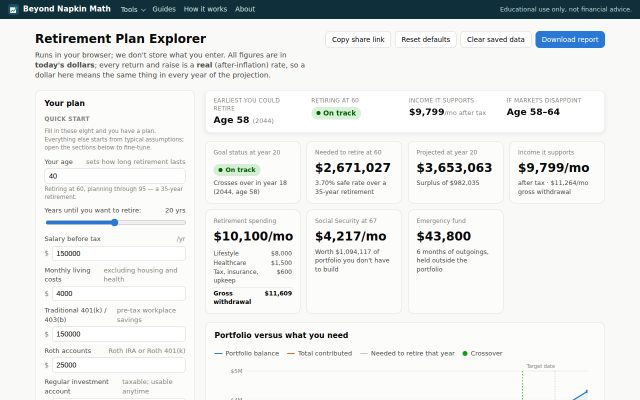
The Retirement Plan Explorer opens with this household retiring at 50. Enter your balances by account type, your planned retirement age, and the age your retirement accounts open (55 if you'll use the Rule of 55). It shows the bridge years, what you can reach, and the shortfall. Our guide to retiring at 50 works through a full plan. It runs in your browser and we don't store your numbers.
More guides for this tool
- Health insurance before Medicare: budgeting for it in early retirement
- How much do you need to retire at 50? A worked example
- How much do you need to retire early?
- Retire at 60 or at 65? What the extra five years are worth
- Sequence of returns risk: why the order of market returns matters more than the average
- The 4% rule: where it comes from, and when it's the wrong number
 Run your own numbers
Retirement Plan Explorer
When could you retire? 401(k), Roth and taxable savings, in today's dollars.
Open the tool →
Run your own numbers
Retirement Plan Explorer
When could you retire? 401(k), Roth and taxable savings, in today's dollars.
Open the tool →