Biweekly mortgage payments: what they really save
Paying half your mortgage payment every two weeks sounds like a clever trick. It works, but not because of anything special about two weeks. There are 26 two-week periods in a year, so you make 26 half-payments: the same as 13 monthly payments instead of 12. The savings come from that one extra payment a year, and you can get them without a biweekly program.
1. What it saves
A $300,000, 30-year loan at 6.5% has a principal and interest payment of $1,896.20 and costs $382,637 in interest on schedule. One extra payment a year is the same as adding $158.02 a month ($1,896.20 ÷ 12):
- The loan is paid off 5 years 10 months early.
- It saves $87,259 of interest.
- You pay $45,668 of extra principal along the way.
Making the 13th payment once a year as a lump sum saves a little less ($83,986 and 5 years 8 months), because the money arrives later.
2. It depends on your rate and how far in you are
| Loan | Monthly payment | Time saved | Interest saved |
|---|---|---|---|
| $300,000, 30 years at 3% | $1,264.81 | 3 years 6 months | $20,345 |
| $300,000, 30 years at 6.5% | $1,896.20 | 5 years 10 months | $87,259 |
| $300,000, 30 years at 8% | $2,201.29 | 7 years 1 month | $137,726 |
| $200,000, 20 years left at 6.5% | $1,491.15 | 2 years 10 months | $25,776 |
The higher the rate and the more years left, the more one extra payment a year does.
3. The catches in biweekly programs
- Fees. Some third-party biweekly services charge a setup fee or a fee per payment. On a loan where the extra payment saves about $87,000, a fee looks small, but it buys nothing you can't do yourself.
- Money held, not applied. Some programs collect your half-payment every two weeks but only send a full payment to the lender once a month. That earns the program interest on your money, and the 13th payment may only reach your loan once a year.
- Not every servicer accepts half-payments. Some treat a half-payment as a partial payment and hold it until the rest arrives.
Ask your servicer how they apply biweekly payments before signing up for anything.
4. The free way to do the same thing
- Add one-twelfth of your payment each month as extra principal ($158 in the example). Most servicers let you set this up online.
- Or send one extra payment a year, from a tax refund or bonus. It saves almost as much.
- Mark the extra "principal only" and check your statement shows it.
If you're paid every two weeks and like matching payments to paychecks, a biweekly setup through your own servicer, with no fee, is fine. The point is the extra payment, not the schedule.
Try it with your numbers
The Mortgage Payoff Calculator opens with this example: one-twelfth of the payment added each month. Enter your loan and set the extra to your own payment divided by 12. Our guide to extra monthly payments shows what larger amounts do. It runs in your browser and we don't store your numbers.
More guides for this tool
- How to get rid of PMI: the 78% and 80% rules
- Should you pay off a 3% mortgage early? Why it rarely wins
- Should you pay off your mortgage before you retire?
- Should you pay off your mortgage early?
- Tax refund or bonus: put it on the mortgage or invest it?
- What an extra $100, $250 or $500 a month does to your mortgage
- Why your mortgage payment went up: escrow shortages explained
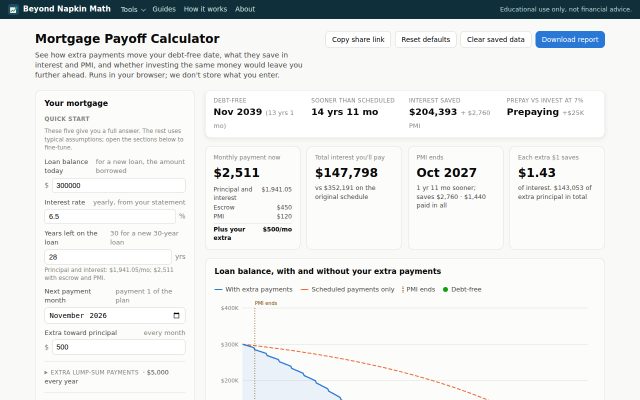 Run your own numbers
Mortgage Payoff Calculator
Extra payments, PMI and the real question: pay it down or invest?
Open the tool →
Run your own numbers
Mortgage Payoff Calculator
Extra payments, PMI and the real question: pay it down or invest?
Open the tool →