Should you pay off your mortgage before you retire?
Retiring with no mortgage is a common goal: a smaller fixed bill means smaller withdrawals and less worry in a bad market. But the money that pays off the loan early isn't being invested, and the mortgage is a debt that ends on its own. Here's how to weigh the two, with one worked example.
1. The example
A 50-year-old with a $200,000 balance at 5.5% and 22 years left, paying $1,307.70 a month in principal and interest. On schedule the loan ends at 72, ten years into a retirement planned for 62.
- To be mortgage-free at 62 takes an extra $593 a month for 12 years.
- That's $85,320 of extra payments, which saves $71,603 of interest.
- Without the extras, the balance at 62 is about $120,500, with 120 payments still to go.
2. Prepaying vs investing the same $593
Compare two households with the same budget. One prepays and, once the loan is gone at 62, invests everything it was paying. The other pays on schedule and invests the $593 a month. Both are measured when the original loan would have ended, at 72, with gains taxed at 15%:
| If investments earn | Prepay, then invest | Invest the $593 | Ahead |
|---|---|---|---|
| 4% a year | $271,315 | $234,406 | Prepaying by $36,909 |
| 6% a year | $296,824 | $293,087 | Prepaying by $3,737 |
| 7% a year | $310,694 | $329,293 | Investing by $18,599 |
The break-even is a 6.18% return. Many people shift toward bonds as they near retirement, and a balanced portfolio's expected return can be below that. So for someone in their 50s, prepaying a 5.5% loan holds up better than it would for a 30-year-old with decades of stock returns ahead.
3. How much savings does a mortgage in retirement really need?
A common argument for paying it off: "$15,700 a year of payments at a 4% withdrawal rate means you'd need $392,000 more saved." That treats the mortgage as a cost that lasts forever. It doesn't. Here it's ten years of payments, then nothing.
The money needed at 62 to cover those 120 payments, if the savings earn 4% a year, is about $129,000. At 5% it's about $123,000. That's close to the balance itself (about $120,500), not three times it. A mortgage that outlasts your working years needs roughly its balance in extra savings, not a 4%-rule multiple.
4. Reasons to pay it off anyway
- Lower withdrawals in the early years, when a market drop does the most damage. That's sequence of returns risk, explained in our guide.
- Lower taxable income. Mortgage payments funded from a traditional 401(k) or IRA are taxable withdrawals. A smaller withdrawal can keep you in a lower bracket, and in some cases reduce the tax on Social Security or keep health insurance subsidies.
- Peace of mind. It's a real benefit, even if the numbers can't price it.
5. Reasons not to
- Liquidity. Money in the house can't pay for a new roof or a health crisis without borrowing or selling. Invested money can.
- A low rate. At 3%, prepaying rarely wins; see our 3% mortgage guide.
- Unfinished priorities. Catch-up contributions to a 401(k) or IRA after 50, the full employer match, and an emergency fund come first for most people.
- Draining retirement accounts to do it. A large lump-sum withdrawal from a traditional 401(k) to pay off the loan is taxable income in one year. It can push you into a much higher bracket.
Try it with your numbers
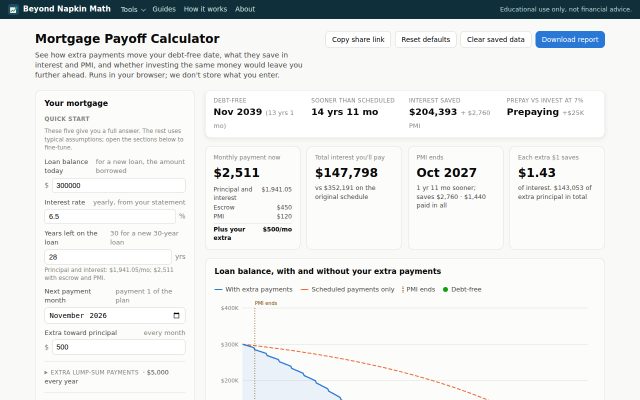
The Mortgage Payoff Calculator opens with this example. Change the extra payment until the debt-free date lands where you want it, and compare prepaying with investing at your expected return. The Retirement Plan Explorer shows how the mortgage affects your retirement date. It runs in your browser and we don't store your numbers.
More guides for this tool
- Biweekly mortgage payments: what they really save
- How to get rid of PMI: the 78% and 80% rules
- Should you pay off a 3% mortgage early? Why it rarely wins
- Should you pay off your mortgage early?
- Tax refund or bonus: put it on the mortgage or invest it?
- What an extra $100, $250 or $500 a month does to your mortgage
- Why your mortgage payment went up: escrow shortages explained
 Run your own numbers
Mortgage Payoff Calculator
Extra payments, PMI and the real question: pay it down or invest?
Open the tool →
Run your own numbers
Mortgage Payoff Calculator
Extra payments, PMI and the real question: pay it down or invest?
Open the tool →