Tax refund or bonus: put it on the mortgage or invest it?
A tax refund or year-end bonus is the easiest extra mortgage payment there is: the money isn't in your monthly budget, so you won't miss it. Whether it should go to the loan or into investments comes down to one comparison: your mortgage rate against what you'd expect to earn, after tax. Here it is with real numbers.
1. The example
A $300,000 balance at 6.5% with 28 years left: $1,941.05 a month in principal and interest. Each year, $3,000 from a refund or bonus goes straight to principal.
- The loan is paid off 6 years 11 months early.
- It saves $99,293 of interest, from $63,000 of extra payments over the years.
- Each extra dollar saves about $1.58 of interest over the life of the loan.
A single $3,000 payment this spring, made only once, saves $14,455 and 8 months. The same $3,000 near the end of a loan does much less: on a $150,000 balance with 10 years left, it saves only $2,519. The earlier in the loan, the more each dollar does.
2. Mortgage or investments?
To compare fairly, give two households the same $3,000 a year. One prepays, and once the loan is gone, invests everything it was paying. The other pays on schedule and invests the $3,000 each year. After 28 years, with gains taxed at 15%:
| If investments earn | Prepay, then invest | Invest each refund | Ahead |
|---|---|---|---|
| 4% a year | $206,016 | $140,017 | Prepaying by $65,998 |
| 7% a year | $225,306 | $218,379 | Prepaying by $6,927 |
| 10% a year | $246,741 | $354,835 | Investing by $108,094 |
The break-even return is 7.25% a year in a taxable account, or 6.70% in a tax-free account. A 6.5% mortgage is a close call against long-run stock returns.
At a 3% rate it isn't close. The same $3,000 a year saves $34,209, and investing wins at any return above 3.42%. Our guide to paying off a 3% mortgage covers that case.
3. How to decide
- Rate above about 7%: prepaying is hard to beat without taking a lot of risk.
- Rate around 5–7%: a toss-up. Prepaying is guaranteed; investing probably comes out ahead over decades, with ups and downs. Splitting the refund is a reasonable answer.
- Rate below about 4%: investing usually wins, as long as you actually invest the money.
Before either, the refund has better jobs: building an emergency fund, paying off credit cards, and getting any employer 401(k) match you're missing.
4. Make the payment count
- Mark it "principal only". Some servicers hold unlabeled extra money toward the next payment, which saves nothing. Check your next statement.
- Don't expect a lower payment. Extra principal shortens the loan; the monthly payment stays the same. Some lenders offer a "recast" that lowers the payment after a large lump sum, usually for a fee.
- If you still pay PMI, a lump sum can bring forward the day you can cancel it. See how to get rid of PMI.
Try it with your numbers
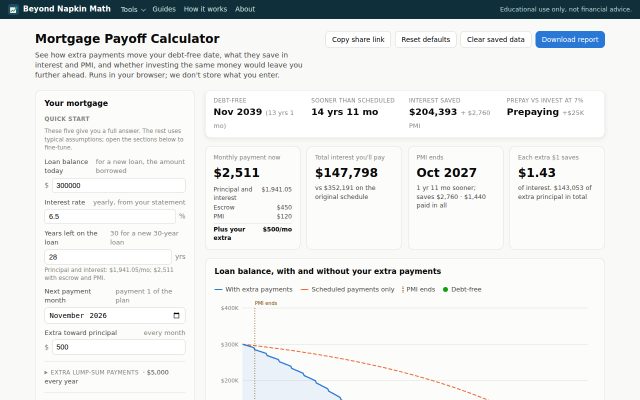
The Mortgage Payoff Calculator opens with this example: a $3,000 lump sum every year. You can also add one-off payments for a specific month. It shows the interest saved, the new payoff date, and how prepaying compares with investing at your expected return. Our guide to extra monthly payments covers the other way to prepay. It runs in your browser and we don't store your numbers.
More guides for this tool
- Biweekly mortgage payments: what they really save
- How to get rid of PMI: the 78% and 80% rules
- Should you pay off a 3% mortgage early? Why it rarely wins
- Should you pay off your mortgage before you retire?
- Should you pay off your mortgage early?
- What an extra $100, $250 or $500 a month does to your mortgage
- Why your mortgage payment went up: escrow shortages explained
 Run your own numbers
Mortgage Payoff Calculator
Extra payments, PMI and the real question: pay it down or invest?
Open the tool →
Run your own numbers
Mortgage Payoff Calculator
Extra payments, PMI and the real question: pay it down or invest?
Open the tool →