Why your mortgage payment went up: escrow shortages explained
Your rate is fixed, yet the payment just went up by $150. On a fixed-rate loan, the culprit is almost always escrow: the part of your payment that covers property tax and homeowners insurance. When those bills rise, the escrow account comes up short, and your servicer raises the payment to cover both the shortfall and next year's higher bills.
1. How escrow works
Each month, part of your payment goes into an escrow account, and your servicer pays the tax and insurance bills from it. Once a year, the servicer does an escrow analysis. It projects the coming year's bills, works out the monthly deposit needed, and compares what's in the account with what should be there. Federal rules (Regulation X, under the Real Estate Settlement Procedures Act) set how this works:
- A cushion. The servicer may keep extra in the account, but no more than one-sixth of the year's estimated bills, about two months' worth.
- A surplus. If the account has $50 or more above what's needed, the servicer must refund it within 30 days of the analysis.
- A shortage. If the account is short, the rules on how you repay depend on its size (section 3).
2. Why the payment jumps so much
A higher bill raises your payment twice:
- Next year's deposits go up to match the new, higher bills.
- Last year's shortfall gets repaid, because the account paid the higher bill with deposits set for the old one, and the cushion has to be rebuilt.
Say property tax rises $1,200 a year and insurance $600. The escrow deposit rises by $150 a month ($1,800 ÷ 12) for the new bills alone. If the shortfall from the past year is also spread over 12 months, the payment rises by more than that in the first year, then settles at the new level.
Property tax often jumps after a sale (many places reassess at the purchase price) or when an exemption you hadn't applied for is missing. Insurance premiums have risen sharply in some regions.
3. Your options when there's a shortage
- Shortage of less than one month's escrow deposit: the servicer can let it ride, ask you to repay it within 30 days, or spread it over at least 12 months.
- Shortage of a month's deposit or more: the servicer can let it ride or spread it over at least 12 months, but it can't demand it all at once. Most servicers also let you pay it in a lump sum voluntarily, which lowers the new payment.
Paying the shortage up front doesn't save money; it just moves when you pay. It's worth doing if the higher monthly payment strains your budget.
4. Check the analysis
- Compare the tax and insurance amounts with your actual bills. Errors happen, such as a missing homestead exemption or an old insurance premium.
- Shop the insurance. A lower premium lowers the escrow deposit at the next analysis. You can also ask for a new analysis after the change.
- Appeal the assessment if the property tax value looks too high. Most counties have a yearly window to do so.
5. What it does to an extra-payment plan
If you've been paying extra toward principal, a higher escrow deposit can quietly eat it. Take a $300,000 loan at 6.5% with 28 years left, paying $500 a month extra with $450 of escrow:
| Debt-free in | Total interest | |
|---|---|---|
| Before: $500 extra, $450 escrow | 16 years 11 months | $195,124 |
| Escrow rises to $600, total payment kept the same (so only $350 goes to extra principal) | 19 years 1 month | $223,944 |
| Escrow rises to $600, extra kept at $500 (total payment up $150) | 16 years 11 months | $195,124 |
Paying the same total after an escrow increase costs over two years and about $29,000 of interest in this example. Escrow itself never touches your balance, so what matters is how much extra still reaches principal. When escrow changes, decide on purpose which way you want to go.
Try it with your numbers
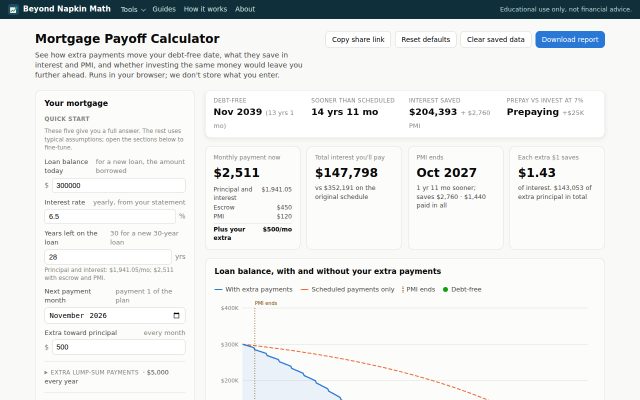
The Mortgage Payoff Calculator opens with the "before" example. Enter your new escrow amount and the extra you'll actually pay, and it shows your new debt-free date and total payment. It runs in your browser and we don't store your numbers.
Your servicer's escrow analysis statement shows the exact shortage and options for your loan.
More guides for this tool
- Biweekly mortgage payments: what they really save
- How to get rid of PMI: the 78% and 80% rules
- Should you pay off a 3% mortgage early? Why it rarely wins
- Should you pay off your mortgage before you retire?
- Should you pay off your mortgage early?
- Tax refund or bonus: put it on the mortgage or invest it?
- What an extra $100, $250 or $500 a month does to your mortgage
 Run your own numbers
Mortgage Payoff Calculator
Extra payments, PMI and the real question: pay it down or invest?
Open the tool →
Run your own numbers
Mortgage Payoff Calculator
Extra payments, PMI and the real question: pay it down or invest?
Open the tool →