Should you pay off a 3% mortgage early? Why it rarely wins
Many homeowners who bought or refinanced in 2020 and 2021 have mortgages around 3%. Paying one off early feels responsible, and being debt-free is worth something. In money terms, though, a 3% loan is one of the cheapest debts you'll ever have. Extra payments only win if the alternative would earn less than about 3.4% a year. Here's the math.
1. The example
A $250,000 balance at 3% with 25 years left: $1,185.53 a month in principal and interest, and $105,658 of interest still to pay. The owner has $500 a month to spare and wonders whether to send it to the loan.
- Prepay: $500 a month extra pays the loan off 9 years 6 months early and saves $42,897 of interest. Once the loan is gone, the whole payment plus the $500 goes into investments.
- Invest: pay the loan on schedule and invest the $500 a month from day one.
Both households spend the same each month. The question is which has more after 25 years, when the original loan would have ended. Gains are taxed at 15% when sold.
2. What each choice is worth
| If investments earn | Prepay, then invest | Invest from day one | Difference |
|---|---|---|---|
| 3% a year | $218,109 | $210,985 | Prepaying ahead by $7,124 |
| 4% a year | $227,448 | $238,760 | Investing ahead by $11,313 |
| 5% a year | $237,296 | $271,437 | Investing ahead by $34,141 |
| 7% a year | $258,628 | $355,293 | Investing ahead by $96,665 |
The break-even, where both end level, is a 3.41% return in a taxable account, or 3.04% inside a tax-free account such as a Roth IRA. Any return above that and investing wins, and the gap grows quickly.
3. Why the bar is so low
An extra dollar toward a loan earns exactly the loan's rate, guaranteed: here, 3%. Every dollar of interest saved also has to be weighed against what that dollar could do elsewhere. At 3%, each extra dollar saves only about 46 cents of interest over the life of the loan. On a 6.5% loan, the same $500 a month saves $115,668, and the break-even return rises to 7.24%. That one is a genuine coin flip; the 3% loan isn't.
Inflation helps too. Your payment is fixed in dollars, so every year it takes a smaller share of a rising income. A 3% loan with inflation around 3% costs almost nothing in real terms.
4. When paying it off still makes sense
- You'd spend the money otherwise. The comparison assumes the $500 really gets invested every month. If it would drift into spending, the loan is a forced saving plan that works.
- You can't stand market risk. 3% guaranteed beats a bad decade in stocks. The table shows long-run averages, not a promise.
- Retirement is near. A smaller fixed payment lowers what you have to withdraw each month. Our guide on paying off the mortgage before you retire works through that case.
- Peace of mind. Owning your home outright is worth something the numbers don't capture. Just know what it costs: in this example, up to about $97,000 by the end, if markets do well.
5. Do these first
- Keep an emergency fund. Money sent to the loan can't come back without borrowing.
- Pay off anything charging more than 3%, which is nearly every other debt: credit cards, car loans, student loans.
- Take the full employer 401(k) match and use tax-advantaged accounts first.
- If safe savings, such as a high-yield savings account or Treasury bills, pay more than your mortgage rate after tax, the case for prepaying weakens further. Check current rates.
Try it with your numbers
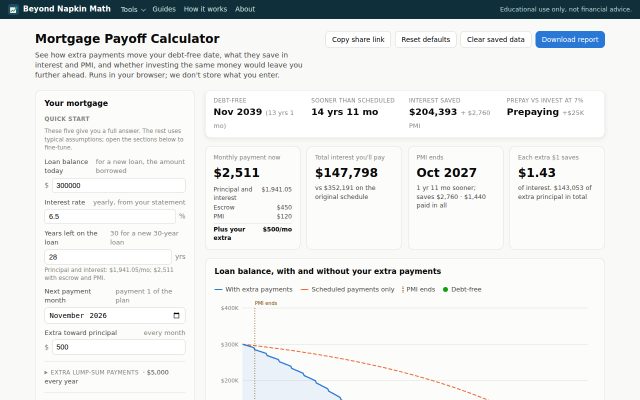
The Mortgage Payoff Calculator opens with this example. Enter your own balance, rate and extra payment. Under "Invest instead" you can set your expected return and the tax on gains, and it shows the break-even return for your loan. Our guide on paying off a mortgage early covers the wider question. It runs in your browser and we don't store your numbers.
More guides for this tool
- Biweekly mortgage payments: what they really save
- How to get rid of PMI: the 78% and 80% rules
- Should you pay off your mortgage before you retire?
- Should you pay off your mortgage early?
- Tax refund or bonus: put it on the mortgage or invest it?
- What an extra $100, $250 or $500 a month does to your mortgage
- Why your mortgage payment went up: escrow shortages explained
 Run your own numbers
Mortgage Payoff Calculator
Extra payments, PMI and the real question: pay it down or invest?
Open the tool →
Run your own numbers
Mortgage Payoff Calculator
Extra payments, PMI and the real question: pay it down or invest?
Open the tool →