How DSCR lenders size a rental loan
A DSCR loan qualifies the property, not you. Instead of checking your pay stubs and debt-to-income ratio, the lender asks one question: does the rent cover the loan payment, with room to spare? That's the debt service coverage ratio. It's also the single best quick test of whether a rental can carry its debt, whatever kind of loan you use.
1. The ratio
DSCR = income ÷ debt payments. Above 1.0, the property covers its loan; below 1.0, you're topping it up. Two versions are in common use:
- Lender's version (most DSCR mortgages): monthly rent ÷ PITIA, the principal, interest, property taxes, insurance and any HOA dues.
- Commercial version (and the calculator): net operating income ÷ principal and interest. Net operating income is rent less vacancy, management, maintenance, taxes, insurance and other running costs.
For a $285,000 house rented at $2,650, with a $213,750 loan at 7.25%:
| Calculation | DSCR | |
|---|---|---|
| Lender's version | $2,650 ÷ $1,857 PITIA | 1.43 |
| Calculator's version | $20,623 NOI ÷ $17,498 a year of payments | 1.18 |
The lender's version ignores vacancy, repairs and management, so it looks better. The calculator's version is the one that tells you whether the property actually pays for itself. Use the lender's to know if you'll be approved, and the calculator's to know if you should be.
2. What lenders look for
- Minimum DSCR: commonly 1.0 to 1.25 on the lender's version. Some lend below 1.0 at a higher rate and larger down payment.
- Down payment: usually 20–25%, more for short-term rentals or low credit scores.
- Rate: typically higher than a conventional investment-property mortgage.
- Prepayment penalties are common, such as 5%, 4%, 3%, 2%, 1% of the balance over the first five years. Check before you plan to refinance or sell early.
- Rent figure: the lease, or an appraiser's market rent estimate if the property is vacant.
3. How much you can borrow
Turn the ratio around: the most a lender will lend is the loan whose payment the income covers at their minimum. On the calculator's stricter basis, a 1.25 target for this house means at most $1,375 a month of principal and interest: a loan of about $201,500, or 71% of the price, rather than 75%.
4. What moves the ratio
| Change | DSCR (calculator's version) | Cash flow a month |
|---|---|---|
| As above: 25% down, 7.25% | 1.18 | $61 |
| 30% down | 1.26 | $158 |
| Rate 6.25% | 1.31 | $203 |
| Interest-only payments | 1.33 | $228 |
Interest-only raises the ratio by lowering the payment, but you build no equity from payments. Over 10 years it leaves this deal about $7,000 worse off after tax than the amortizing loan, and the payment jumps when the interest-only period ends.
5. Short-term rentals and the haircut
Lenders often count only 75–80% of projected short-term rental revenue, or require a year of booking history. The same house as a furnished short-term rental has a DSCR of 1.09 on the calculator's basis. With a 20% lender haircut on revenue, it falls to 0.64, a likely decline.
What this leaves out
Each lender has its own formula, minimum and pricing grid; get a term sheet before you rely on a number. The calculator's DSCR uses year-one figures and doesn't include reserves for big repairs (it shows those separately in cash flow).
Try it with your numbers
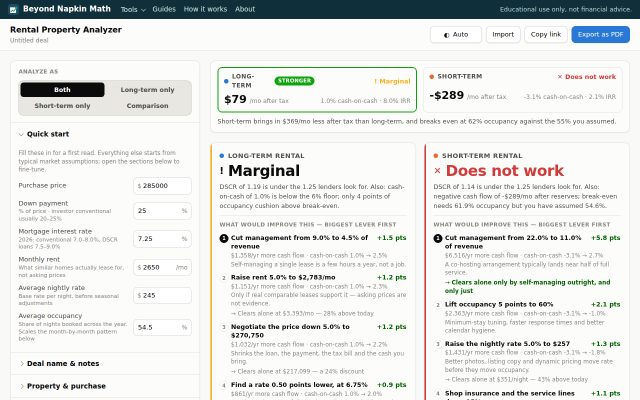
The Rental Property Analyzer opens with this house. Enter the price, rent, down payment, rate and costs. It shows DSCR against a 1.25 target, the cash flow, and how both hold up if rates rise or rents fall; for short-term rentals, turn on the lender revenue haircut. See also cash-on-cash vs cap rate vs IRR. It runs in your browser and we don't store your numbers.
More guides for this tool
- Airbnb break-even: the occupancy and nightly rate you need
- Can rental losses offset your W-2 income?
- Cash-on-cash return vs cap rate vs IRR (and DSCR): which number to trust
- How much to budget for vacancy, repairs and capex on a rental
- How to stress-test a rental before you buy
- Long-term vs. short-term rental: how to compare the numbers
- Pay cash or finance a rental property?
- Rental property depreciation, cost segregation and recapture, in plain English
- The 1% rule is napkin math. What to check instead
- When short-term rental rules kill the deal
 Run your own numbers
Rental Property Analyzer
Long-term vs short-term rental: cash flow, returns and taxes, side by side.
Open the tool →
Run your own numbers
Rental Property Analyzer
Long-term vs short-term rental: cash flow, returns and taxes, side by side.
Open the tool →