How to stress-test a rental before you buy
Every rental looks fine with the seller's rent and an average year. The question that protects you is what happens when things go wrong, because over ten years some of them will. A stress test changes one thing at a time, then all of them together, and checks whether you'd still be able to carry the property.
1. The deal
A $285,000 single-family house rented at $2,650 a month, 25% down at 7.25%, with 6% vacancy, 9% management, 6% maintenance and 8% set aside for big repairs. Year one: about $61 a month of cash flow after those reserves, a cash-on-cash return of 0.9%, and a DSCR of 1.18.
2. The five shocks
| Scenario | Cash flow a month | DSCR |
|---|---|---|
| As expected | $61 | 1.18 |
| Interest rate 2 points higher (an adjustable reset or refinance) | −$239 | 0.98 |
| Rent 10% lower | −$131 | 1.03 |
| Vacancy up to 15% | −$122 | 1.04 |
| Operating costs 20% higher (insurance, taxes, labor) | −$133 | 1.07 |
| Recession: rate +1, rent −10%, vacancy 12%, costs +10%, no price growth | −$477 | 0.82 |
Every single shock turns this deal negative. None is extreme: insurance premiums in many states have risen faster than 20% in recent years, and a 15% vacancy year is just one long gap between tenants.
3. Reading the result
- Break-even occupancy. This house needs 91% occupancy to cover its costs, against 94% expected. One extra month empty in a year wipes out the cash flow.
- The recession line is about survival: could you cover $477 a month from your own pay for a year or two without selling? If yes, the deal is risky but survivable. If not, it's a bet.
- Cash reserves. A common rule is six months of the property's expenses in cash. Stress results tell you if that's enough.
4. What a sturdier deal looks like
The same house at a 6.5% rate gives $168 a month and a DSCR of 1.27. Three of the four single shocks now leave it within $30 a month of break-even, and only the rate shock goes clearly negative, at −$124. A reasonable target: positive or near zero in every single shock, and a recession loss you could carry from savings.
Ways to get there: negotiate the price, put more down, buy down the rate, find a property with lower taxes or insurance, or accept that the return will come from appreciation and loan paydown, not monthly cash. That last one is a legitimate strategy, as long as you plan for it.
5. Stress the exit too
The calculator values the sale at the end of your holding period. With no price growth at all over 10 years, this deal's after-tax return drops from 8.5% a year to about 2%. If the plan depends on prices rising, that's worth knowing before you sign.
What this leaves out
The shocks are applied to year one and held; real downturns come and go. The model doesn't include a major uninsured repair, a lawsuit or an eviction, which is why the reserve line matters. Local rent and vacancy data should replace these assumptions.
Try it with your numbers
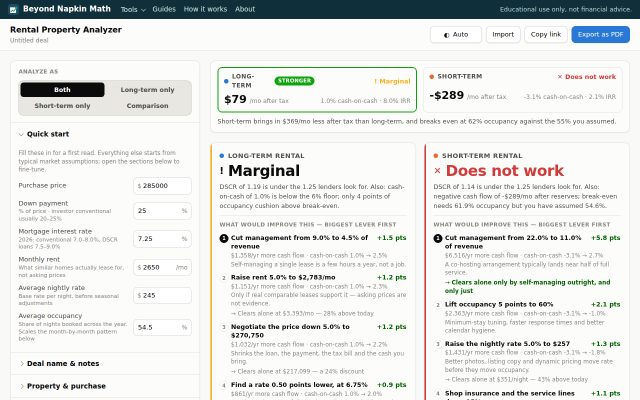
The Rental Property Analyzer opens with this deal. Enter the listing's price, rent and costs, your loan terms and expected vacancy. It runs all five stress tests, shows break-even occupancy and DSCR, and suggests which change would fix a failing deal. See also rental expenses, vacancy and repairs. It runs in your browser and we don't store your numbers.
More guides for this tool
- Airbnb break-even: the occupancy and nightly rate you need
- Can rental losses offset your W-2 income?
- Cash-on-cash return vs cap rate vs IRR (and DSCR): which number to trust
- How DSCR lenders size a rental loan
- How much to budget for vacancy, repairs and capex on a rental
- Long-term vs. short-term rental: how to compare the numbers
- Pay cash or finance a rental property?
- Rental property depreciation, cost segregation and recapture, in plain English
- The 1% rule is napkin math. What to check instead
- When short-term rental rules kill the deal
 Run your own numbers
Rental Property Analyzer
Long-term vs short-term rental: cash flow, returns and taxes, side by side.
Open the tool →
Run your own numbers
Rental Property Analyzer
Long-term vs short-term rental: cash flow, returns and taxes, side by side.
Open the tool →