Can rental losses offset your W-2 income?
A rental can put money in your pocket and still show a loss on your tax return, because depreciation is a deduction you don't pay for in cash. Whether that loss lowers the tax on your salary is a separate question, and for most people with good incomes the answer is "not yet". Here are the rules that decide it, and what they're really worth.
1. The paper loss
A $285,000 single-family rental, bought with 25% down at 7.25% and rented for $2,650 a month. In year one:
| Year one | |
|---|---|
| Net operating income (rent less vacancy and running costs) | $20,623 |
| Mortgage interest | −$15,429 |
| Depreciation (the building over 27.5 years) | −$8,498 |
| Taxable result | −$3,304 |
The property's cash flow is slightly positive, about $61 a month after reserves, but for tax it lost $3,304.
2. The default: losses are "passive" and wait
The tax code treats rental income as passive. Passive losses can offset only passive income, such as profits from other rentals. Anything left over is suspended and carried forward, year after year, until your rentals show a profit or you sell the property in a taxable sale, when all of its suspended losses are released at once.
So a suspended loss isn't lost. It's deferred, often for a decade.
3. Three ways a loss can offset your salary
- The $25,000 allowance. If you "actively participate" (you approve tenants, set rents, arrange repairs, even with a property manager), up to $25,000 a year of rental losses can offset other income. It phases out by 50 cents per dollar of modified AGI over $100,000, and is gone at $150,000. It isn't indexed for inflation. Married couples filing separately who lived together get none.
- Real estate professional status. More than 750 hours a year in real estate businesses, and more than half your working time. A full-time W-2 employee can't usually qualify, though a spouse who works in real estate can, on a joint return. You must also materially participate in the rentals.
- The short-term rental rule. If guests stay seven days or less on average, the property isn't a "rental activity" under the passive rules. If you also materially participate (commonly, 100 hours and more than anyone else, or 500 hours), its losses are non-passive and offset your salary at any income. This is the "short-term rental loophole".
For the house above, the $3,304 loss at a 24% tax rate is worth $793 in year one if it can offset other income, and nothing now if it can't.
4. Cost segregation makes the stakes bigger
A cost segregation study splits out parts of the property (appliances, carpet, fixtures, site work) that depreciate over 5, 7 or 15 years. With 100% bonus depreciation, restored for property acquired after January 19, 2025, those parts can be written off in year one. For this house, with a quarter of the building reclassified:
| Year one | Standard depreciation | Cost segregation |
|---|---|---|
| Depreciation | $8,498 | $64,799 |
| Tax loss | $3,304 | $59,604 |
| Tax saved if the loss offsets salary | $793 | $14,305 |
| If it doesn't | $0, suspended | $0, suspended; about $32,700 still unused after 10 years |
Run as a short-term rental with the loophole, the same study gives a year-one loss of $80,236, saving $19,257 in tax, even though the property loses $357 a month in cash.
5. What it's really worth
Depreciation is mostly a timing benefit. Every dollar you deduct lowers your basis, and at sale that part of the gain is "recaptured" at up to 25%. For the house over 10 years, the total after-tax profit is about $92,000 with or without cost segregation; what changes is when you get it. Taking the tax savings in year one lifts the after-tax return (IRR) from 8.5% to 9.6% a year, if the losses offset salary. If they're suspended, cost segregation adds nothing but a bigger recapture bill.
Recapture is covered in rental depreciation and recapture.
What this leaves out
The calculator applies one flat tax rate, doesn't phase the $25,000 allowance by income (you choose whether losses offset), and doesn't model state rules, some of which don't follow federal bonus depreciation. Material participation and real estate professional status are fact-heavy tests that the IRS audits; keep a time log. Speak to a tax professional before buying a property for its tax losses.
Try it with your numbers
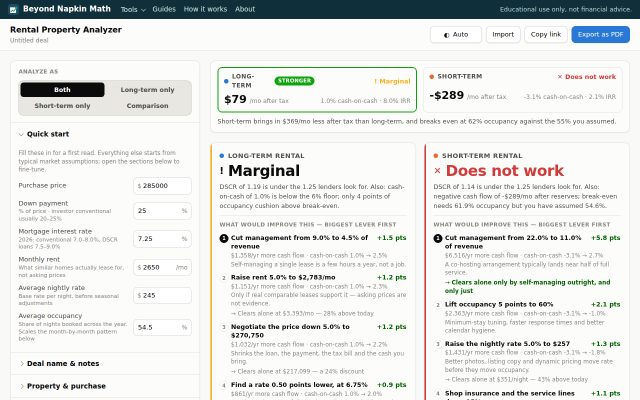
The Rental Property Analyzer opens with this house, cost segregation on and losses set to offset other income. Turn the options on and off: losses offsetting other income, cost segregation, and for a short-term rental the seven-day rule. It shows the year-one tax result, the losses carried forward, and the after-tax return over your holding period. It runs in your browser and we don't store your numbers.
More guides for this tool
- Airbnb break-even: the occupancy and nightly rate you need
- Cash-on-cash return vs cap rate vs IRR (and DSCR): which number to trust
- How DSCR lenders size a rental loan
- How much to budget for vacancy, repairs and capex on a rental
- How to stress-test a rental before you buy
- Long-term vs. short-term rental: how to compare the numbers
- Pay cash or finance a rental property?
- Rental property depreciation, cost segregation and recapture, in plain English
- The 1% rule is napkin math. What to check instead
- When short-term rental rules kill the deal
 Run your own numbers
Rental Property Analyzer
Long-term vs short-term rental: cash flow, returns and taxes, side by side.
Open the tool →
Run your own numbers
Rental Property Analyzer
Long-term vs short-term rental: cash flow, returns and taxes, side by side.
Open the tool →