Pay cash or finance a rental property?
Paying cash for a rental gives you strong monthly income and nothing to lose sleep over in a downturn. Financing it lets the same money buy more, and earns a higher percentage return when prices rise. Which is better depends on one comparison: is the property's return higher than your mortgage rate? At today's rates, that's closer than many people assume.
1. The same house, two ways
A $285,000 single-family house rented at $2,650 a month, held for 10 years, with 3% a year rent and price growth:
| All cash | 25% down at 7.25% | |
|---|---|---|
| Cash in at the start | $292,125 | $80,513 |
| Cash flow a month, after reserves | $1,519 | $61 |
| Cash-on-cash return, year one | 6.2% | 0.9% |
| After-tax return over 10 years (IRR) | 6.6% | 8.5% |
| After-tax profit over 10 years | $204,912 | $92,030 |
| Money back per dollar in | 1.70 | 2.14 |
| Recession stress (cash flow a month) | $1,129 | −$477 |
The all-cash buyer makes more money in total, because they put far more in. The financed buyer earns more per dollar, and could buy three or four such houses with the same cash, taking on three or four times the risk.
2. Leverage cuts both ways
The property itself returns about 7% a year (its cap rate) plus price growth. Borrowing at 7.25% to earn that is only a good trade because prices are expected to rise. Take away the price growth:
| With no price growth | All cash | Financed |
|---|---|---|
| After-tax return over 10 years | 4.7% | 2.2% |
| After-tax profit | $130,137 | $17,255 |
Now the cash buyer does better on every measure. At a 6% mortgage rate, with growth, the financed return rises to 10.4% a year. The lower the rate, the more financing helps.
3. The middle path
Putting 50% down gives $547 a month of cash flow, a DSCR of 1.77 and a 7.4% after-tax return: less than the 25% down deal in a good market, much safer in a bad one. Many investors finance with a larger down payment, then pay the loan down from cash flow, or refinance when rates fall.
4. Other things to weigh
- Where the cash would otherwise go. Money in a paid-off rental can't be spent in an emergency without selling or borrowing against it. A diversified index fund might return as much with no tenants.
- Interest is deductible against rental income, which lowers the after-tax cost of the mortgage. The figures above include this.
- Buying with cash wins negotiations. Sellers often take a lower all-cash offer. A cash buyer can still take out a loan afterwards ("delayed financing") if they want the money back.
- Investment property loans cost more than home loans and usually need 20–25% down. See how DSCR lenders size a rental loan.
What this leaves out
The model holds rates fixed for the 10 years and sells at the end, with recapture and capital gains tax. It doesn't value the time and risk of managing more properties, or the option to refinance. Returns are before your own time.
Try it with your numbers
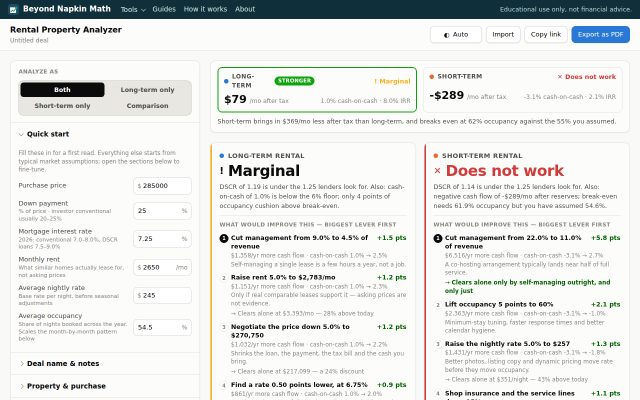
The Rental Property Analyzer opens with this house bought for cash. Turn "all cash" on and off, change the down payment and rate, and compare cash flow, cash-on-cash, IRR and the stress tests. The deal comparison lets you save both versions side by side. See also cash-on-cash vs cap rate vs IRR. It runs in your browser and we don't store your numbers.
More guides for this tool
- Airbnb break-even: the occupancy and nightly rate you need
- Can rental losses offset your W-2 income?
- Cash-on-cash return vs cap rate vs IRR (and DSCR): which number to trust
- How DSCR lenders size a rental loan
- How much to budget for vacancy, repairs and capex on a rental
- How to stress-test a rental before you buy
- Long-term vs. short-term rental: how to compare the numbers
- Rental property depreciation, cost segregation and recapture, in plain English
- The 1% rule is napkin math. What to check instead
- When short-term rental rules kill the deal
 Run your own numbers
Rental Property Analyzer
Long-term vs short-term rental: cash flow, returns and taxes, side by side.
Open the tool →
Run your own numbers
Rental Property Analyzer
Long-term vs short-term rental: cash flow, returns and taxes, side by side.
Open the tool →