When short-term rental rules kill the deal
A short-term rental's biggest risk usually isn't the market. It's a rule: a city ordinance, a permit cap, a homeowners' association covenant. Many cities have restricted short stays in recent years, sometimes with little notice. A deal that only works as a short-term rental is a bet that the rules won't change for as long as you own it.
1. The rules that end deals
| Rule | What it does | How bad |
|---|---|---|
| Primary residence only | Only owners who live there most of the year (often 180 to 275 days) can rent short-term | Ends an investment short-term rental entirely |
| HOA, condo or deed restriction | Private covenants ban stays under 30 days, or any rental | Ends it, even where the city allows it |
| Night cap | A limit on rented nights a year, sometimes as low as 90 or 120 | Caps revenue below what most deals need |
| Permit or license required | Permits can be capped, waitlisted, or end when the property is sold | Can't operate until you have one |
| Pending restrictions | A proposal under debate, or a recent ban nearby | Underwrite the fallback |
| Saturation | Listings growing faster than visitors | Nightly rates fall first, then occupancy |
2. What a night cap does to the numbers
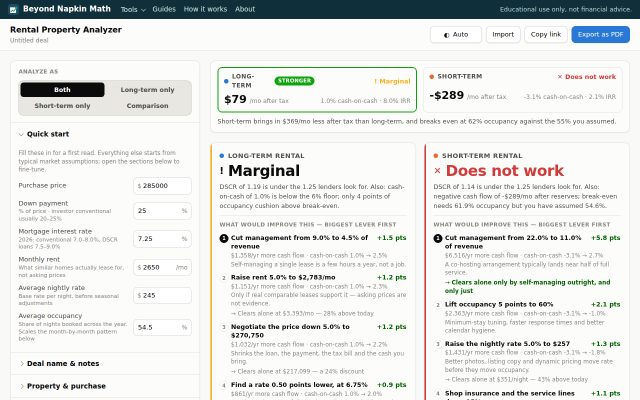
The $285,000 house as a short-term rental at $245 a night, expecting 54.5% occupancy, already loses $357 a month after reserves. Under caps:
| Rented nights a year | Occupancy | Cash flow a month |
|---|---|---|
| No cap (the market's level) | 54.5% | −$357 |
| 180-night cap | 49.3% | −$556 |
| 120-night cap | 32.9% | −$1,182 |
3. The fallback: a furnished house on a lease
If short stays are banned, the house goes on a long-term lease. Here that's $2,650 a month, which gives about $61 a month of cash flow. But you've already spent $19,000 on furniture, so the return on the $99,513 you put in is 0.7% a year, against 0.9% for someone who bought it to lease in the first place. The furniture's resale value is a fraction of its cost.
That's the test for every short-term rental deal: would you still be glad to own it as a long-term rental? If yes, the rules are a risk to your upside. If no, they're a risk to your savings.
4. Checks before you buy
- Read the city or county code for short-term rentals, and the minutes of recent council meetings. Search local news for proposals.
- Read the HOA documents (covenants, conditions and restrictions, and any rental rules), not the listing agent's summary.
- Ask whether the permit transfers to a buyer and whether there's a waitlist.
- Check zoning: some areas allow short stays only in certain districts.
- Check lodging taxes and registration rules, and who collects them.
- Insurance: a standard homeowners' or landlord policy usually doesn't cover short-term guests.
What this leaves out
Rules differ by city and change often; nothing here describes a particular place. Grandfathering, enforcement and fines vary widely. The calculator's risk checklist flags the rules you tick and shows the long-term rental fallback in the stress table; it doesn't know your local law.
Try it with your numbers
The Rental Property Analyzer opens with this house as a short-term rental under a 120-night cap. Enter your property, tick the rules that apply in the risk checklist, and set occupancy to what the rules allow. The stress table includes a "short-term rental banned" row that shows the house as a long-term rental after you've paid for the furniture. See also Airbnb break-even. It runs in your browser and we don't store your numbers.
More guides for this tool
- Airbnb break-even: the occupancy and nightly rate you need
- Can rental losses offset your W-2 income?
- Cash-on-cash return vs cap rate vs IRR (and DSCR): which number to trust
- How DSCR lenders size a rental loan
- How much to budget for vacancy, repairs and capex on a rental
- How to stress-test a rental before you buy
- Long-term vs. short-term rental: how to compare the numbers
- Pay cash or finance a rental property?
- Rental property depreciation, cost segregation and recapture, in plain English
- The 1% rule is napkin math. What to check instead
 Run your own numbers
Rental Property Analyzer
Long-term vs short-term rental: cash flow, returns and taxes, side by side.
Open the tool →
Run your own numbers
Rental Property Analyzer
Long-term vs short-term rental: cash flow, returns and taxes, side by side.
Open the tool →